
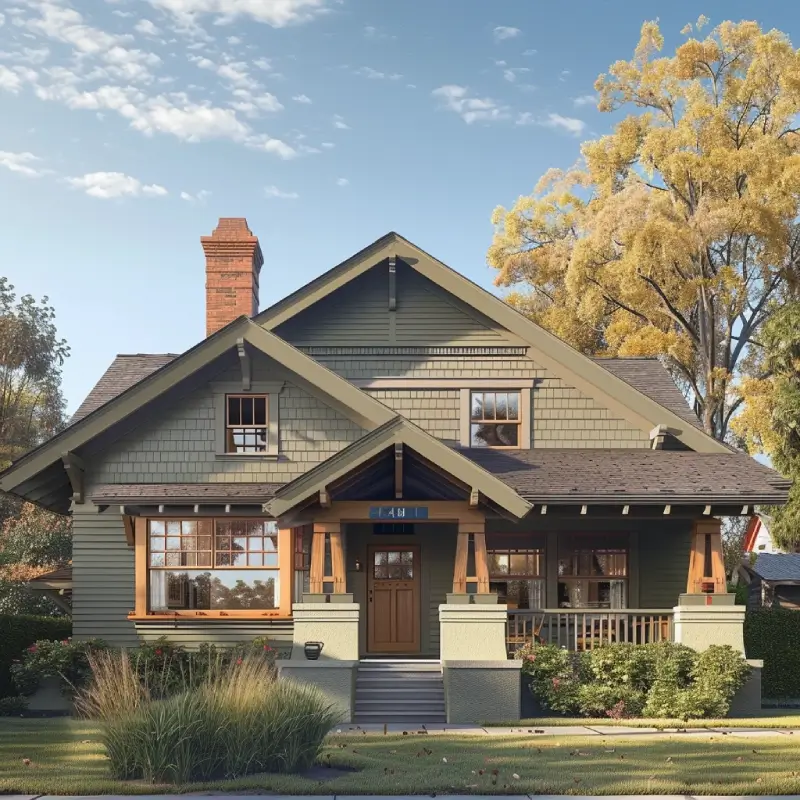

After testing more than a dozen green exterior paint colors on my own home, I learned something surprising: most greens look completely different outdoors than they do on a paint chip. Sunlight, surrounding trees, roof color, and even your climate can dramatically change how a color reads. These are the five Benjamin Moore green exterior paint colors I narrowed it down to, including the one I chose…


Benjamin Moore Rolling Hills
Benjamin Moore Rolling Hills is a designer favorite for a reason. It works just as well on an old Craftsman like the home above as a new build. It has both gray and brown undertones, which allows it to morph like a chameleon in different lights. For this reason, it’s also a favorite for interiors. However, with a Light Reflective Value (LRV) of 23.41, this shade was simply too dark for my taste. I live in a climate with very hot, sunny summers and wanted a lighter color that would mitigate heat gain. Sadly, Rolling Hills was not a fit for me.


Benjamin Moore Saybrook Sage
Benjamin Moore Saybrook Sage is a stunning true sage gray-green. I’m sure it looks beautiful on an overcast day, but on the Craftsman above, you can see how it looks on a bright sunny day. Unfortunately, with an LRV of 44.91, this color simply wouldn’t work in my sunny climate. In bright sun, it appears light and almost gray. I wanted a true green no matter the lighting, so I continued my search. However, this would be a beautiful option for a home in the Pacific Northwest.


Benjamin Moore Passion Vine
Benjamin Moore Passion Vine is a true olive color and an authentic Craftsman green. While it looks warm and rich in golden hour light like on the home above, in my opinion in direct daylight—especially when viewed next to other greens—it shows up a bit baby puke-y. Also with an LRV of 21.53, it would be far too dark for my home. But if you’re going for a classic Craftsman color palette of olive green, rich cream, and rusty red, this would be a great option for you.


Benjamin Moore Louisburg Green
Benjamin Moore Louisburg Green was a strong contender for me. It’s the perfect LRV of 32.77—light enough to prevent heat gain but dark enough to still hold true in bright light, like on the home above. However, I felt like it was just slightly too cool-toned for my home, which is surrounded by warmer green foliage—including towering pecan trees and the ferns I hang around my front porch. I needed a slightly warmer green that wouldn’t tone-clash with all of my greenery.


Benjamin Moore Creekside Green — my pick!
Benjamin Moore Creekside Green ended up being my perfect shade. It’s in that perfect lightness range with an LRV of 30.68 and has enough gray and brown undertones to hold its own against my warm foliage without blending in or clashing.
Benjamin Moore says, “This richly saturated shade is reminiscent of a stroll alongside a quiet creek bed on a warm summer’s day.”
I love paint color descriptions.
In some lights Creekside Green appears like olive, in other lights like sage, and when it’s overcast like a soft gray-green. It’s the perfect mood ring, chameleon-like shade—my favorite kind of paint color. I find myself stopping and staring at it often, just admiring it. I love how it turned out.
For more of my exterior painting journey, check out How to Paint Old Peeling Wood Siding or my Exterior Paint highlight on Instagram.
How to Choose the Right Green Exterior Paint Color
Choosing a green exterior paint color sounds simple… until you start looking at all of the options. There are so many beautiful greens, but the tricky part is that a color that looks perfect on a tiny paint chip can look completely different once it’s covering the entire exterior of your home.
After testing different greens, I learned that the “right” color depends on so much more than just whether you like green. The lighting, materials, and surroundings of your home all play a huge role in how that color will actually look.
Warm vs. Cool Greens
One of the first things to consider is whether you want a warm green or a cool green.
Warm greens usually have more yellow, brown, or earthy undertones, which can make a home feel cozy, historic, and connected to nature. These greens tend to work beautifully on older homes, cottages, and homes surrounded by trees or landscaping.
Cool greens often have more blue or gray undertones, giving them a more modern, calming feel. These can look beautiful on homes with cooler materials like gray stone, black accents, or crisp white trim.
The tricky part? Some greens that look like a perfect sage on a paint swatch can pull much cooler (or even gray) once they are outside. That’s why I always recommend testing large samples on your actual home before committing.
Consider How Much Sun Your Home Gets
Exterior paint colors can change dramatically depending on the amount of sunlight your home receives.
A color that looks soft and muted in a shaded area can become much brighter and more vibrant in direct sunlight. If your home gets a lot of sun, you may want to choose a slightly deeper or grayer green so it doesn’t feel too bright once it’s on your exterior.
On the other hand, homes surrounded by trees or with limited natural light can often handle richer, darker greens without feeling overwhelming.
I always recommend looking at your samples throughout the day—morning, afternoon, and evening—because the color you love at one time of day might surprise you at another.
Think About Your Home’s Existing Materials
Your exterior paint color needs to work with the other materials that aren’t changing, like brick, stone, or siding.
If your home has warm brick with red, orange, or brown tones, earthy greens often pair beautifully because they complement those warm undertones. A cooler green can sometimes create too much contrast.
For homes with gray stone or cooler-toned materials, a blue-green or sage green may feel more natural.
And if you have a fully sided home, you have a little more flexibility—but you’ll still want to consider the color of your trim, doors, and any other accents.
Don’t Forget About Your Roof Color
Your roof takes up a huge amount of visual space, so it’s one of the biggest things to consider when choosing an exterior paint color.
Warm brown roofs tend to pair well with olive, mossy, and earthy greens, while black or charcoal roofs can look amazing with deeper forest greens or cooler sage colors.
If your roof has strong undertones, make sure your green paint complements them instead of competing with them. A paint color can look completely different depending on what it’s sitting next to.
Look at Your Landscaping
One of my favorite things about green exterior paint is how beautifully it blends with nature—but your surroundings can also change how a green reads.
If your home is surrounded by lots of greenery, you may want a green with enough contrast so your house doesn’t disappear into the landscape. A slightly grayer or deeper green can help your home stand out while still feeling connected to its surroundings.
If your yard has fewer plants or a more neutral landscape, you may be able to choose a brighter or more saturated green without it feeling like too much.
Match the Style of Your Home
The architecture of your home can also help guide your color choice.
Historic homes often look beautiful with classic greens like olive, sage, and deep forest shades because these colors feel timeless and grounded.
Craftsman homes tend to pair well with earthy greens that complement natural wood tones, while modern homes can often handle cleaner, cooler greens paired with black accents and simple trim.
Ultimately, the best exterior paint color is the one that feels right for your home. A color might be beautiful in a photo, but the perfect choice is the one that works with your home’s unique lighting, materials, and surroundings.
If you’re looking for more free paint color suggestions, check out the rest of my favorite paint colors, or check out:
My Top 5 Green Exterior Paint Colors by Sherwin-Williams

Hello, Thank you for your posts. I am also painting my home in Connecticut using BM Creekside Green. I am worried that Dove White trim would be too bright a white. Do you recommend a soft off white BM color?
Thank You for the post. Could you please tell me the trim color you used withe the Creekside Green? I am painting my house Creekside and I am worried that Dove white will be much to bright.
Please do blue exteriors and aqua.
What is the trim color on your house you chose to go with the Creekside Green?
It’s Benjamin Moore White Dove!
This was very helpful! We bought a new (old) home in December, and we are in talks about exterior paint. We know we want a green, but that’s as far as we’ve gotten! Thanks for your tips and descriptions of each!
I love your web page. The pictures of homes sure helps in deciding a color. Yo also discuss the undertones of each color which really helps me. Thanks so much!
Thank you so much! I’m glad it’s helpful 😊
I bought two samples to try on my house, a soft white and Creekside Green based on your recommendation. I figured I love olive and sage so either way I should be happy. Well after 3 weeks of rolling my paint job is complete. It only seems to read sage on my house but it looks gorgeous with my terracotta roof tiles and great with wood as well. Thanks for this excellent article, it helped relieve that glazed over look I got after staring for days at samples 🙂 I paired mine with Benjamin Moore Manchester Tan around the windows.
Yay I’m so glad to hear you love Creekside Green, too!
Hi Renee, your house is so charming! I want to thank you for this detailed review of the different greens you tried! It was SO helpful in helping us choose an exterior paint for our lake house. We too have decided on Creekside Green for all the same reasons as you did. Would you mind also sharing your trim color? Not wanting it to be too creamy, I tried White Dove and Swiss Coffee, and both are too stark. Your trim is a nice crisp contrast, but not too stark. Thanks for any direction! Penny
I am so glad to hear you love Creekside Green, too! I used White Dove on my trim, but if you felt it was too bright, Benjamin Moore Dove Wing or Sherwin Williams Oyster White may be better options!
Thanks so much for this post- as someone also trying to pick a green exterior house color it was super helpful! And as a result, I just got a sample of Creekside Green and I also think it’s a winner! I know it hasn’t been very long but has it stood up to fading? Or did you get any info from your paint store on its light fastness? I’m in the Bay Area, albeit a sunnier microclimate than San Francisco.
Yay I’m so glad to hear that! I haven’t noticed any fading, and it’s been up for over a year now in the hot Texas sun.
I am thinking of painting the body of my home White Dove, with either Bronzetone 64 (or 60) OR Creekside Green. Leaning Creekside, partly because of your review. Curious what you think about swapping the body and trim? I have a small Tudor-style home and am thinking Creekside might be too much for it.
Hi Renee,
Thanks for your comments. I’ve decided to paint my house Creekside and I’m wondering if you can share the brand & name of the shingles on the house pictured.
Thanks. William
I have a medium gray trim on my house and would really like to keep the gray trim and paint with creek side. My roof is also gray. What do you think?
Mine is Hampshire Gray. It’s distinctly green… a beautiful saturation and not too grey, not too olive.
Could you please help me – I am 99% settled on Creekside Green for the body, Dove White for my Trim and what I am needing your expertise on is the best complimentary color for my garage door and second floor front accent siding. I have selected SW greenblack 6994 for my front door and have The Barn Company goosneck lighting that frames each garage door and my front door in the Porcelain Enamel black finish https://www.barnlight.com/finish-gallery/porcelain-enamel/150-porcelain-black/ . Today my accent siding on the second floor and the garage is lighter. Should I stay with a color in the same family such as Horizon Gray or Titanium or do you have a better suggestion? – Thank you for your expert guidance! Best- Dee from PNW Oregon
Is there a dark complementary color you think would work with Creekside Green? I’m painting the siding Creekside Green, but would like to find a dark tone to use for my foundation and supports on my front porch.
Hi! Your site is so helpful to me. I was wondering if you have any more information on your reference picture of the Louisburg Green house. I love the trim and accent colors and it would be great to track them down. Thank you and keep up the gorgeous work!
Thank you very much for this helpful article. I am wondering what the green color is in the very first photo before the article – the bungalow next to the title. I am excited to try your suggestions!